 On a recent trip to Spain, I fell in love with the tomato- Solanum lycopersicum- again. The tomatoes tasted so good, even in December, and lots of dishes are made in Spain with tomatoes. The tomatoes I ate in Spain did not have that cardboard taste tomatoes have in winter on the east coast (where I live). Since tomatoes like full sun and well-watered soil, Spain has a perfect climate for growing tomatoes and produces around 3 million tons a year. Tomatoes are classified botanically as a fruit (its seeds are surrounded by an inner flesh), but used in cooking as a vegetable. In addition to vitamins A and C, tomatoes contain fiber, and contain lycopene, which research suggests MAY prevent cancer. They are also cholesterol free and are only 35 calories. Tomatoes are the biggest vegetable crop, and the single most eaten foodstuff in Spain. Annual consumption of fresh tomatoes in this country is almost 40 kg per capita, The Spanish brought the tomato to Europe from the Americas and it was not eaten until the 19th century, but they sure do eat the tomato now. They even have a festival in La Tomatina Buñol in Valencia, Spain. It is held annually on the last Wednesday in August and attracts tens of thousands of visitors. The highlight is the tomato fight, in which 30,000+ participants throw an estimated 150,000 overripe tomatoes (100 metric tons) at each other. http://www.latomatina.es/en Pan con Tomate (Bread with Tomato) or
 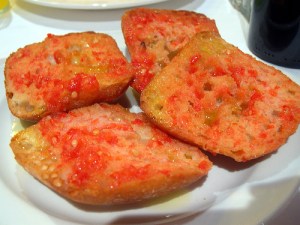 Pan a la Catalana is a simple, well-loved, widely eaten and famous dish from Cataluña. In Catalan, it is called pa amb tomaquet. Click here for a recipe: http://spanishfood.about.com/od/tapas/ss/pancontomate.htm
Author Archives: abdupree
Earthquake Felt in Kansas!

Epicenter of earthquake felt in Olathe, Kansas
Lo and behold, on a recent trip to Olathe Kansas, Science Is My Specialty experienced an earthquake. At 10:53 pm local time I was sitting on the second floor of a very quiet house, in a semi rural part of Kansas—about 30 miles from the center of Kansas City. I was sitting in a chair with my back leaning on the wall and I felt the wall shake back and forth for what seemed like 10-15 seconds. After a few seconds I realized it was an earthquake! Most earthquakes generally occur on fault lines (weaknesses or crack in the earth’s crust) and near tectonic plate boundaries. When underground forces build up over a long time, two bodies of rock slide past each other and earthquakes occur. The earthquake that I felt on Nov 5, 2011 in Kansas, started in Oklahoma. It was an intraplate earthquake. It did not occur directly because of plates colliding. It occurred far away from any plate boundary and was smaller in magnitude than an earthquake that occurs near a fault. The causes of intraplate earthquakes are poorly understood, but it is likely they are related to plates colliding at the plate boundaries. Reoccurrences of intraplate earthquakes are usually are much longer and are rarely felt on the surface. The ground motion caused by intraplate earthquake seismic waves dissipates more slowly. The strong, coherent rocks that make up the interiors of plates transmit seismic energy more efficiently over longer distances than the less coherent, weaker rocks near plate boundaries. This is most likely the reason why the Oklahoma earthquake was felt by people as far away as Illinois. For more information on the Oklahoma earthquake check out: http://earthquake.usgs.gov/earthquakes/dyfi/events/us/b0006klz/us/index.html By the way……..Kansas has a place in popular culture because of the movie the Wizard of Oz. Due to the movie, most people equate tornadoes with Kansas, not earthquakes. Actually if truth be told, Kansas is NOT the number one state for most tornadoes. Texas is followed by Oklahoma as number one and two, with Kansas and Florida tied for number three. Kansas has had some pretty fierce tornadoes and the devastation of a serious tornado is nothing to make light of. But it is interesting to note that Frank Baum’s descriptions of Kansas in his book The Wonderful Wizard of Oz are based on his experiences in drought-ridden South Dakota, not Kansas. Maybe it was easier to say, ”Dorothy, I don’t think we are in Kansas anymore”, than to use South Dakota in the sentence. Anyway you look at it, when we think of Kansas we think of tornadoes, not earthquakes!
Osage Orange Trees in Kansas–Science is My Specialty Heads West!

Fruit of the Osage Orange Tree
This is a story about Osage Orange trees (Maclura pomifera)– also know as hedge apple or horse apples. If you look closely, as I did on my recent trip to semi rural Kansas on the outskirts of Kansas City, you will see many Osage Orange trees. This tree has a distinctive fruit which can be from four to six inches in diameter. The fruit is shed in September and October and can be lethal if by chance you are under a tree when one of the fruits fall! This tree is very durable and transplants easily. It withstands dryness and wet conditions equally well and it can withstand extremes in temperature and soil pH. It also can withstand wind. Here is where the tree is most fascinating. It has a distinctive place in American history. During the early days of farming before barbed wire was developed, farmers planted the Osage Orange tree in rows to mark a fence line or hedgerow. They also used these trees to shield crops from the wind. During the 1930’s a ‘dust bowl’ developed in the midwest due to unimpeded winds blowing across open land. Osage Orange was one of the main trees used as a wind break to shelter plantings.
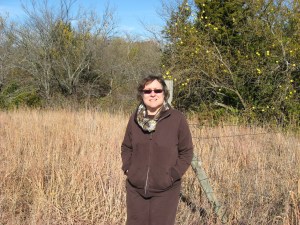
Anita Brook Dupree at the Olathe Kansas Prairie Center with Osage Orange trees behind her.
President Franklin D. Roosevelt launched an ambitious project in 1934 to prevent erosion in the Great Plaines and over the period between 1934 and 1943 ordered the planting of 220 million trees. Over 18,600 miles of trees were planted prevent soil erosion. You can still see many of these trees in Kansas. The tree also has a place in the expansion of America westward. This tree has heavy close-grained wood and was prized by settlers for its use as tool handles, bows, and bowls. It burns slowly and hot allowing this tree to produce fire wood that the settlers used for cooking and heating. The Osage Orange tree has a special place in American history. The next time you see these trees with its distinctive fruit, keep in mind many are over 75 years old and served an important role in stopping the devastating effects of erosion in America’s heartland and provided settlers with many of the raw materials they needed to survive. By the way, I have seen this tree in Philadelphia and other cities. It’s hardy nature allows it to grow where few plants thrive.
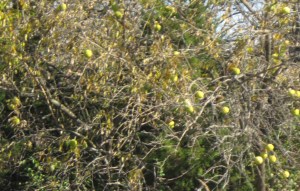
Osage Orange trees usually develop a short trunk with stiff, spiny, interlacing branches.
Mentoring of Candidates for National Board Certification in Science
Mentor candidates for NBPTS science certification. Many rural, remote or small districts do not provide support for candidates. Online mentoring available via Skype and or email.
The Truth About Bats
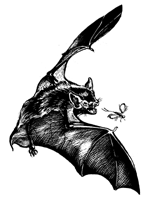
Bats eat hundreds of insects that otherwise might be “eating” you!
It is late October and we all know what that means: Halloween! Bats are part of our Halloween culture. Children love to be scared of bats and love to dangle plastic bats on elastic strings in each other’s faces! Teachers make multiple stencils of bats and children color or decorate them to post around the classroom. All this excitement about bats at Halloween is great but often the real creatures are greatly misunderstood. People think bats are dangerous, dirty, blood sucking creatures that attack humans. Actually bats are quite clean and groom themselves meticulously. Bats do not want to bite you and rarely have rabies, and out of the thousand species of bats on Earth, only three drink blood. Bats are actually very fascinating. Bats are the only flying mammal. The skeleton of a bat is very similar to our skeleton, except the fingers (they are quite long because they make up the wing). Bats are quite diverse. The smallest bat is found in Thailand, and is called the Bumble Bee Bat, and the largest bat found in Java is called a Flying Fox (a misconception…it is not a flying fox but a large bat with a six foot wing span!) Bats provide a valuable service as pollinators. According to Merlin D. Tuttle, a recognized worldwide authority on bats, “Fruit and nectar-eating bats that disperse seeds and pollinate flowers are vital to the survival of rain forests and to the production of associated crops worth millions of dollars annually.” Bats also serve another purpose: They can eat hundreds of mosquitoes an hour (about 600—that equals about 3,000 mosquitoes a night)! And here is another reason to not fear bats: The bacterium that bats produce is being studied as a possible source for antibiotics and as a use in toxic waste cleanup. Someday research on bats might lead to new antibiotics and a cleaner environment. The next time you eat a banana, a mango or a guava (three of the many fruits pollinated by bats), or are annoyed by a mosquito, think of the greatly misunderstood bat and thank bats for all they provide for you.
It’s Official!
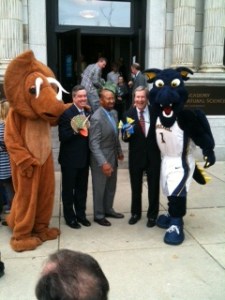
The dinosaur meets the dragon!
The dinosaur met the dragon today at the Academy of Natural Sciences in Philadelphia. The Academy of Natural Sciences with its extensive dinosaur bone collection and working scientists officially became part of Drexel University. (The dragon is the symbol of Drexel University). Mayor Michael Nutter (in grey suit ), Academy President George Gephardt Jr. (right of the Mayor), Drexel President John Fry (left of the Mayor ) and children from Russell Beyers Charter School and Friends Select School were on hand to celebrate the merger. To learn more about the merger, go to: http://www.drexel.edu/now/professionals/releases/archive/2011/October/Drexel-Academy-of-Natural-Sciences-Sign-Affiliation-Agreement/
EPA Announces the 2011 Presidential Innovation Award Program for Environmental Educators
The EPA (Environmental Protection Agency) has announced the 2011 Presidential Innovation Award for Environmental Educators Program. The program is a partnership between the EPA and the White House Council on Environmental Quality (CEQ). This award will recognize outstanding K-12 teachers who use innovative approaches to environmental education and use the environment as a context for learning for their students. There will be two winning teachers from each EPA region and each teacher and school will receive $2000.00 each and a commemorative plaque. For more information on eligibility requirements and selection criteria or to submit an online application, please visit www.epa.gov/education/teacheraward. The application deadline is December 30, 2011.
Science in a Cemetery
SCIENCE (AND HISTORY) IN A CEMETERY
 Ghoulish, macabre, scary, these are all things your middle school students love, so why not combine their love for things gross into a science field trip and visit a cemetery? Not only will a visit to a cemetery catch the interest of your pre-teen students, they can learn a lot of science (and history by the way) while they are there.
EVERY TOWN HAS A CEMETERY
Every town has a cemetery. By their nature, they are usually quiet, peaceful places with trees and other plants that attract animals. Cemeteries are usually old, so examples of weathering are abundant. This is what makes a cemetery a perfect place for a science trip. You may be able to walk to a cemetery in your town. I write this from Philadelphia, Pa. where cemeteries not only provide us with science, but history as well. If you live within a 50-mile radius of Philadelphia, one of its historical cemeteries could be a field trip destination. Mikveh Israel Cemetery (at 8th and Spruce) is the oldest Jewish cemetery in Philadelphia, Pennsylvania. The site, less than 0.2 acres in size, is a registered historic place in Philadelphia and a national historic site administered by Independence National Historical Park. http://www.ushistory.org/mikvehisrael Christ Church Cemetery is a burial ground located at 2nd Street above Market St. in Philadelphia, and is one of the oldest in the country. It is one of America’s most interesting Colonial and Revolutionary Era graveyards. Its 1,400 markers are located on two beautiful acres. Benjamin Franklin and four signers of the Declaration of Independence are buried at Christ Church Burial Ground. http://www.christchurchphila.org/burial Woodlands Cemetery at 4000 Woodland Ave offers the public some of the nation’s most sophisticated Neo classical houses from the years following the American Revolution. Its University City location once was beyond the western edge of the city. The cemetery is still active today, and retains 18th-century buildings, elaborate Victorian funerary monuments, curving green contours, and majestic trees to preserve a park-like setting. www.woodlandsphila.org Laurel Hill Cemetery, the gem of the city’s cemeteries, is located at 3822 Ridge Ave, Philadelphia, Pa. Laurel Hill has taken the “cemetery as destination” to its greatest heights with an active education department, lots of events, school tours and school lessons. Laurel Hill’s programs are varied and teachers have a choice of lessons on Art or Architecture, Civil War/ Military History, Science and Medicine, Victorian Symbolism, Notable Women, or Culinary History. Special tour topics that relate to units being taught in school are also available. www.thelaurelhillcemetery.org GEOLOGY Cemeteries great are places to observe the uses of rocks and metals, and the effect of Mother Nature on these materials. Granite, marble and bronze are popular materials used for tombstones. At Laurel Hill Cemetery the staff will provide visitors with student activity packets called “I Spy Tombstone Hunt.” These packets focus students on aspects of the cemetery such as the weathering of tombstones, erosion of soil due to location, symbolism used in the cemetery, and history related to those buried in the cemetery. FLORA and FAUNA Hundred of trees and most likely the same number of species of trees can be found at Laurel Hill Cemetery (most older cemeteries have lots of trees). Where there are trees, there are birds and other small animals. The cemetery also provides examples of moss, fungus, insects and larger animals. I have heard that Laurel Hill cemetery is home to several foxes and hawks! A FEW THINGS TO CONSIDER Most parents won’t have a problem with signing the trip permission slip, but be very sensitive to the possibility that some might. They may have deep religious convictions that would prevent them from seeing this field trip as anything but educational. You may have to provide a place for a child or two in a colleague’s classroom on the day of the trip. Try talking with the parents first. Make a special phone call to explain. They might just be reacting spontaneously to the idea of a trip to a cemetery and once you explain all the educational benefits, they might agree. Also, be aware that a student might have just had a death in their family, and such a trip might be traumatic. Again, explain to parent and child that this is an educational experience, and try to make them understand that they need to separate the “death” aspect of the cemetery with the other experiences you are trying to share with your students. You might also have to explain all this to your administrator, but in the end, you will see it is worth the extra effort. And keep this in mind: it is usually the adults that have a problem with a trip to the cemetery. The kids love it! Click below for Danse Macabre by French composer Camille Saint-Saëns Danse Macbre
 Students will see evidence of weathering by observing the tombstones. |
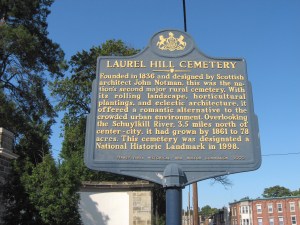 Historic Laurel Hill Cemetery |
When Autumn Leaves Start to Fall
 It is autumn in the northern hemisphere and nowhere are the leaves more beautiful than in the deciduous forests of the northeastern United States. A whole travel and tourism industry is based on viewing the colorful leaves of New England. Just type in “fall foliage tours” into Google and you will see what I mean.
However, many people do not know how and why leaves fall and change colors. The story behind fall foliage is one of the most interesting wonders of the natural world. Let’s start with falling leaves. In the fall when the days get shorter and colder, a hormone is release that tells the plant to begin cutting the leaf where it joins the branch. This area is called the abscission zone. Abscission cells appear in this area and begin to literally cut the leaf off from the tree. The word abscission (from the Latin ab meaning away and scindere meaning to cut) has the same root word as the word scissors, and the main job of the abscission cells is to cut (through the stem of the leaf). The wind is just a helper that finishes the job of the making the leaves fall. The tree has to shed its leaves, because if it does not, the water 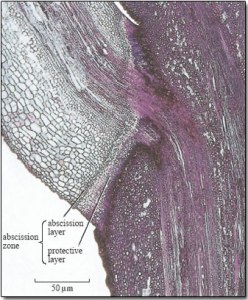 in the leaves will freeze and the tree will die during the winter. To read and hear more about this phenomena, listen to an October 30, 2009 NPR interview on “All Things Considered.” http://www.npr.org/templates/story/story.php?storyId=114288700 As for the colors, when the days get shorter and shorter, a trigger is send throughout the tree to stop the production of glucose (the food produced by the tree). Since glucose production has stopped, the chlorophyll—the green pigment in the leaves—stops being produced. The tree does not produce food during the winter because there is not enough light and water for photosynthesis. When this happens the green color fades away, leaving yellow, orange colors of the leaves. These colors were always there in the leaf, they were just masked by the green in the leaf. The purple and red colors we see are a result of leftover glucose responding to cooler temperatures at night. The browns we see are the result of waste materials left in the leaves. Click here to listen to Edith Piaf singing Autum Leaves
Enter the Green Earth Essay Contest
Attention Student Actors, Environmentalist and Writers
in Philadelphia, Pa
(grades K-6)
Write an essay about ways you and your friends have helped keep the earth green and you could win: • A special performance of the play Go Green (Grades K-6) for your school. • A chance to appear in the play Go Green (produced by the Walnut Street Theater!) • The winning essay will be published in The Philadelphia Inquirer. HOW TO ENTER: In 150 words or less describe the actions that you take on a regular basis to keep the planet free from pollution. Keeping the earth green and free from pollution is an important job for all students. It is up to you as the next generation to protect the planet for the future. Send entries by Friday, November 19 to: Go Green c/o News In Education, Philadelphia Inquirer, PO Box 8263 Philadelphia, PA 19101 or fax to 215-854-2220. Entries can also be e-mailed to: nie@phillynews.com Include your Name, Name of Parent/Guardian, Address, Contact phone number and School. Entries become the property of The Philadelphia Inquirer and may be published at a later date. For Essay Contest Information: 215-854-5178 or log on to: http://nie.philly.com/niecontent/Green_Bully_Half.pdf
 Science is My Specialty
You must be logged in to post a comment.