 Here is how you can help save endangered species. The Philadelphia Zoo is trying to help save orangutans from extinction. Orangutans are in danger because they have lost approximately 80% of their habitat. In the last 20 years palm oil production has taken over the land where they used to live. Palm oil is found in cookies, crackers, and breakfast cereals as well as in shampoo and makeup. It is estimated that orangutans could become extinct in the wild in as few as 25 years UNLESS we do something. One thing students can do is participate in the Zoo’s K-12 UNLESS contests. If you do, your class will be eligible for a free orangutan-focused field trip and will also be able to compete for between $250 and $2,500 in prizes (Grades K-5) or for between $500 and $5,000 in prizes (Grades 6-12). Click here to apply and to read more about the prizes for contest participants. The contest application deadline is October 28, 2011.
Author Archives: abdupree
You Got to Love Those People at Google!
Every couple of days there is something interesting either at the bottom of the Google page or the word Google is transformed into something creative and interesting. This was on Google 10/11/11. I would have never known abut it if it were not for those creative folks at Google! “Your science experiment. 250 miles above Earth. For the whole world to see.” Go to: http://youtu.be/cCkIjrUqz_g Then click on the video:
How to Enter the Space Lab Competiton
All you science teachers out there have to check this out. This website explains how you can submit an experiment and have it performed on the International Space Lab at very low gravity.
Partnerships with Community Organizations
Coordinate with community partners such as museums and universities for implementation of grants and research projects aligned to your curriculum. Coordinate professional development offered through these partners in conjunction with your school.
One Teacher’s Trash is a Science Teacher’s Treasure
One Teacher’s Trash is Another Teacher’s Treasure
-Uses for Things Found-
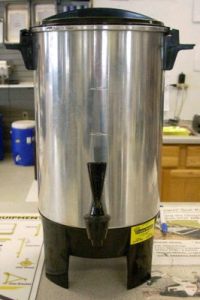 We have all heard the phrase, “one person’s trash is another person’s treasure.” No group of people are more wiling to take and use anything than classroom teachers. And science teachers must be the worst. But this is not something to be looked upon as negative, because it actually speaks to the basic core of science and science teaching. Science is everywhere. Science needs to be taught using hands on inquiry based lessons. Science requires simple models to teach complex concepts. So objects, found or received, are always welcome in the science classroom. My school district received a large donation of materials from refurbishment center that went out of business. The men on our loading dock said to me, as they were unloading the shipment, “I don’t think these boxes are worth anything, they are just a bunch of Styrofoam balls, bottles of vegetable oil, bottles of shampoo and bags of sponges used in the kitchen.” My reply: great science equipment! Don’t throw any of these things out. Here are some of my suggestions for things we found in the donated materials. CARDBOARD SHEETS (cut into 8 x 17 inch rectangles) Trash to you, but to me, these sheets of cardboard represent boards to press a push pin into to demonstrate the construction of a circle and an ellipse. When teaching about the orbits of the planets in astronomy, I would cut up old boxes with an Exacto knife to get pieces of cardboard. What a terribly time consuming job that was! SPONGES Something to wash the dishes with? Well yes, but not to me! A sponge is a substrate to germinate seeds. One sponge can be cut into four pieces (cut when dry) and students can place seeds on the sponge to see germination. KIDNEY BEAN SEEDS, EXPIRATION DATE PASSED Do not toss these beans. Usually they will still germinate, despite the expiration dates. Test a few to be sure. But if they do not germinate, they still can be used. Use the beans to demonstrate diffusion. Trace the bean on a sheet of paper in your science notebook. The soak the bean overnight. Dry the bean. Trace the bean 24 hours later. Observe the size difference. Or, after soaking over night, dissect the bean seed. You will see the seed coat, the embryo, and the two cotelydons. VEGETABLE OIL The concept of density is one that requires numerous explanations and demonstrations. Vegetable oil, combined water, vinegar, soap detergent and other liquids can be used to make a density column in a graduated cylinder. SHAMPOO I worked in an urban school district and getting soap that lathered up was sometimes a challenge. If you should come across bottles of liquid soap, do not discard them. Put them in empty soap containers with the plunger thing and pretend they are brand new. In addition to being used as soap to wash hands, many experiments can be done with liquid soap. I was required to teach about viscosity when we studied lava that comes out of volcanoes when they erupt. I used various liquids, thick and thin, placed on a tilted board to observe their flow. Students can use stop watches or timers to calculate rate of flow of various liquids and relate these to various types of lava (Aa lava etc) Cash Register Tape I have seen activities with cash register tape to teach about the Geological Time Scale. Another use can be a way to demonstrate distances in space. Pepper Pepper can be used to teach about static electricity, or used as an example of separating two compounds by physical means. Large Coffee Pots This was one of the best finds of them all. Many teachers tell me they do not have running water in their room, so they shy away from hands on activities. I see a large 42 cup coffee pot as the answer! Fill the pot with water and use the spigot to draw out water when you need it for labs. Stop at every yard sale you see and get a few for your classroom. The next time you think about throwing something out, think of a teacher first. Science requires simple models to teach complex concepts. So objects, found or received, are always welcome in the science classroom.
Integration of Science and Literacy
The Pine at Timber-Line
by Harriet Monroe
What has bent you,
Warped and twisted you,
Torn and crippled you?—
What has embittered you,
O lonely tree?
You search the rocks for a footing, dragging scrawny roots;
You bare your thin breast to the storms, and fling out wild arms behind you;
You throw back your witch-like head, with wisps of hair stringing the wind.
You fight with the snows,
You rail and shriek at the tempests.
Old before your time, you challenge the cold stars.
Be still, be satisfied
Stand straight like your brothers in the valley,
The soft green valley of summer down below.
Why front the endless winter of the peak?
Why seize the lightning in your riven hands?
Why cut the driven wind and shriek aloud?
Why tarry here?
There is a lot of science in this poem! This poem is full of metaphors, personifications, and deeper meaning, as many poems are. But it is also a science lesson. If I were teaching this poem in a high school English class, I would be sure to take some time to discuss the science behind the descriptions of the tree. The author, Harriet Monroe poses the questions,
What has bent you,
Warped and twisted you,
Torn and crippled you?—
What has embittered you,
O lonely tree?
An astute observer will say that the wind has bent the tree, and the fact that it is singular tree is important. One “lonely” tree at the timber line (a line marking the upper limit of tree growth in mountains or northern latitudes) would be bent by winds that blow through the valley. The poet then says:
You search the rocks for a footing, dragging scrawny roots;
This too poses scientific facts. Plants produce an enormous amount of seeds that are dispersed through the air and fall randomly on the earth’s surface. A small bit of soil, between the cracks of a rock is often enough for the seed to germinate and then the roots take hold and “search for a footing” in soil within or below the hard rock surface. Many of us have seen weeds growing between the cracks of the sidewalk or trees taking root in urban settings. The same situation holds true in the forest, in rocky areas, or as the poem describes, at the timber line. While the tree cannot actually grow out of bare rock, it can begin to grow from small amounts of soil and debris that collect in pockets of the rock. Over time the tree may grow well enough to send roots into the rock itself, causing the rock to split and making it appear that the tree has sprung from within the rock instead of from its surface. The poet states:
You bare your thin breast to the storms, and fling out wild arms behind you;
You throw back your witch-like head, with wisps of hair stringing the wind
A solitary tree will have a multitude of branches and leaves to maximize exposure to light.
The poet asks:
Why front the endless winter of the peak?
Why seize the lightning in your riven hands?
Why cut the driven wind and shriek aloud?
Why tarry here?
All living things, and trees are no exception find optimal solutions to common survival problems. By chance the tree took root in an inhospitable place, and thrived, despite the odds, manages to thrive. Winston Churchill had it right when he said, “Solitary trees, if they grow at all, grow strong.” In this age of “not enough time to teach science” a teacher might seize the opportunity to integrate a science and literature into a lesson.
Hope Floats in Baltimore Harbor
 The National Aquarium and the City of Baltimore have collaborated on a project of installing floating wetlands in Baltimore Harbor. This new pilot project is hoping to investigate the potential of floating wetlands as a way of improving water quality and restoring habitat. Floating islands have been used in small water systems and scientists are hoping that they will see good results in the Chesapeake Bay. The floating island is intended to help clean up pollution in the bay. The plants’ roots soak up pollution and excess nutrients that run off the land. Under the island, animals use the oxygen produced by the plants. The island also provides shelter for aquatic animals. The island was made with recycled plastic and is woven around over 450 native species of plants. Here is a video featuring the installation of the island: http://youtu.be/OcUGnKabz3A For more information check out: http://news.aqua.org/tag/floating-wetlands/
Big Cats Conference
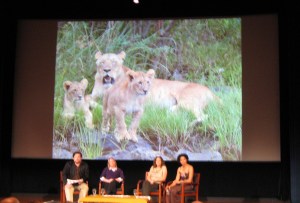
On stage are the “Lion Ladies” with moderator Luke Dollar, a wildlife conservationist in Madagascar: Amy Dickman, Laly Lichtenfeld, Paula Kahumu.
The 20th century had “Leakey’s Angles,” and the 21st century has the “Lion Ladies.” “Leakey’s Angels” is a relatively recent name given to three women sent by archaeologist Louis Leakey to study primates in their natural environments. The three are Jane Goodal, Dian Fossey, and Birute Galdikas. They studied chimpanzees, gorillas and orangutans respectively. Goodal and Galdaikas are still alive and still involved in primate research (Goodall is 77 and Galdaikas is aged 65). Dian Fossey was murdered in 1985. The dedication of “Leakey’s Angels” to the well being of the primates they study mirrors the dedication of the three “Lion Ladies” I met at the Big Cats Conference in Washington DC. The so called “Lion Ladies” were on several panels throughout the conference and spoke about their work with the Big Cats in Africa. Here is a brief description of who these “Lion Ladies” are. “Amy Dickman is a conservationist, wildlife ecologist and zoologist and has worked in Africa for more than 13 years. National Geographic’s Big Cats Initiative is supporting Amy’s current project, which focuses on large carnivore ecology in Tanzania’s Ruaha landscape and strives to minimize human-carnivore conflict on village land adjacent to Ruaha National Park. She works with the Tanzania Carnivore Project and is a Big Cats Initiative Grantee” . www.tanzaniacarnivores.org “Dr. Laly Lichtenfeld has a passion for Africa. She lives in Tanzania and is co-founder and the executive director of the African People & Wildlife Fund and a research affiliate of Yale University’s School of Forestry and Environmental Studies. She has over 15 years of experience in East Africa working with large carnivores, local communities and village-based conservation programs. Her work has been featured on Nat Geo Wild and Discovery Channel Canada. She is a Big cats Initiative Grantee.” “Paula Kahumbu, executive director of the Kenya Land Conservation Trust and WildlifeDirect, and chairman of the Friends of Nairobi National Park, was coached and mentored by paleoanthropologist and conservationist Richard Leakey, who remains one of her closest allies and supporters. She is a Big Cats Initiative grantee and a 2011 Nat Geo Emerging Explorer. http://www.klct.or.ke
Paula Kahumu ate dinner at our table and someone said: “Pay attention, we MAY be dining with a future Nobel Peace Prize winner!” ”
On stage are the “Lion Ladies” with moderator Luke Dollar, a wildlife conservationist in Madagascar: Amy Dickman, Laly Lichtenfeld, Paula Kahumu.
Wangari Maathai
While I was in Washington DC at National Geographic’s Big Cats conference, an announcement was made that Wangari Maathai, Nobel Peace Prize Laureate, died. at age 71. Ban Ki-moon, Secretary General of the United Nations said in a statement published on the UN website that Maathai was a “globally recognized champion for human rights and women’s empowerment” and a “pioneer in articulating the links between human rights, poverty, environmental protection and security.” It is ironic that she should die during the conference dedicated to saving the Big Cats of our planet. So much of their survival is linked to human rights, economics, poverty, environmental protection and security. A few hours after Wangari’s death was announced, one of the presenters, Paula Kahumbu, said that her mother sent her a video clip from her home in Kenya. We were shown this video at the conference. Check it out and share. Nobel Peace Prize In 2004 the Norwegian Nobel Committee awarded the Nobel Peace Prize to Maathai for her contribution to sustainable development, peace, and democracy. Wangari Maathai’s philosophy resonates loud and clear when considering the plight of the Big Cats. Here is a quote from the Nobel Committee: “Peace on earth depends on our ability to secure our living environment. Maathai stands at the front of the fight to promote ecologically viable social, economic and cultural development in Kenya and in Africa. She has taken a holistic approach to sustainable development that embraces democracy, human rights and women’s rights in particular. She thinks globally and acts locally,” the Committee said when it announced its decision to award her the Nobel Peace Prize. “Maathai combines science, social commitment and active politics. More than simply protecting the existing environment, her strategy is to secure and strengthen the very basis for ecologically sustainable development,” the Committee added.
New York Times Education Supplement: Strangers in a Strange School
Some Solutions (in Education) Are Both Simple and Drastic at the Same Time Has anyone read the New York Times Education supplement from 9/18/11, especially the article called Strangers in a Strange School? I was impressed by an article from the New York Times magazine, Sunday Sept 18, 2011. (The education issue). There is a story about an American couple in Russia that sent their three children to a unique Russian school. The children did not speak Russian when they started, and received no special classes in Russian Language. (However, when you read the article you will see they did get some special treatment. For example when the youngest child was being teased in class, the principal instructed the teacher to teach the class exclusively in English. The students who previously teased the American quickly understood how frustrating it was to not know the language and soon stopped the teasing). The school is called New Humanitarian School is run by a man named Vasily Bogin. Bogin set up a system of “curators” a kind of tutor for groups of children. Here in a nutshell is what he did: (It is brilliant). He has 2 to 3 teachers who do not teach but oversee 10 to 15 children in each grade. These teachers observe classes and notice when problems occur, (and deal with them). They stay until 6 pm to work with children on their homework. These curators eat breakfast, lunch and snacks with the children and everyone is served meals in a cafeteria where “comfort food is served by doting cooks”. The idea of having extra adults around to help the main teacher deal with problems (academic or otherwise) as they arise is simple. But it is “drastic” in the sense that these teachers are extras, and are often cut when budgets are slim. In the long term, such investments are invaluable. For a fascinating story of one family’s educational adventure read the whole article: Strangers in a Strange School by Clifflord Levy in this week’s 9/18/11 New York Times Magazine. nytimes.com/magazine
STEM Smart: Lessons Learned from Successful Schools
 STEM CONFERENCE at Drexel University, Philadelphia Pa STEM Smart: Lessons Learned From Successful Schools was presented by NSF in response to the National Research Council’s desire to present the findings of research done to identify highly successful k-12 schools and programs in STEM education. The National Science Foundation’s report was summarized in a series of panel discussions and remarks by NSF staff and various prominent educators and professionals in STEM education. For conclusions and more information on the study, refer to: www.nap.edu/catalog.php?record_id=13230 What conclusions did I draw from the day? 1) “Effective instruction capitalizes on students’ early interest and experiences, builds on what they know, and provides them with experience to engage in the practices of science” 1 This kind of effective science instruction is the exception, not the rule in this country. Attention to these key elements in effective instruction is required if we are to meet the goals for U. S. STEM education. (see below) 2) Adequate instruction time is essential. NCLB has affected the time allotted for STEM instruction. The predominant focus in elementary school is mathematics and language arts because these subjects are tested yearly for accountability. Decrease in time for science instruction is “of particular concern because there is some evidence that interest in science careers develops as early as the elementary years.” 2 3) “ To be effective, teachers need content knowledge and expertise in teaching.”3 Today many teachers have not majored in college in subjects they teach. Effective professional development that is sustained, addresses classroom and school problems, and is focused on developing a teacher’s ability to teach content needs to be available. GOALS FOR U. S. STEM EDUCATION
- Expand the number of students who ultimately pursue advanced degrees and careers in STEM fields and broaden the participation of women and minorities in those fields.
- Expand the STEM-capable workforce and broaden the participation of women and minorities in that workforce.
- Increase STEM literacy for all students, including those who do not pursue STEM-related careers or additional study in the STEM disciplines.
1,2,3: From the report: www.nap.edu/catalog.php?record_id=13230
 Science is My Specialty
You must be logged in to post a comment.