Bagels, Pizza, and Clean Water

imagesMany New Yorkers say that the best bagels and pizza crust in the world can be found in New York City.  They say it’s the water that makes the bagels and the pizza crust taste so good.  Urban Legend? Scientific truth?  Let’s take a look.

Italian American chef Lidia Bostianch commented about this on a recent episode of her cooking show called “Lidia’s Italy in America”.  Pizza makers in New York City swear it is the water that makes their pizza crust so good. While demonstrating how to make a great pizza crust she said that she has heard of restaurateurs outside of the City shipping New York City water to their restaurants to make crust that tastes like authentic New York City pizza.

 The claims don’t stop with the pizza! Bagel shops in Brooklyn also swear that the reason their bagels are so good is because they use New York City water.  Bagels from New York City, which are made with water and boiled in water before they are baked, have a unique taste.   Bagel makers swear by the virtues of bagels made with real authentic New York City water.   One chain that opened in Florida claimed to have reproduced the chemical make-up of New York City water.

 New York City water is highly praised by many people, not just pizza and bagel makers.  This is shocking to some people who do not know that New York City’s renowned tap water tastes so good because it is piped from large upstate reservoirs, 125 miles outside the city.  The watershed that supplies water to over 8 million residents per day is well protected.  One of the methods used to protect the watershed was to keep the wilderness in certain areas in upstate New York undeveloped.  The City of New York purchased land through which the water flows.  Beginning in the 1830s, the City of New York created a water system generally considered having no equal in the world.

The water that flows through the pipes in New York City originates in giant reservoirs in the Catskill Mountains. As it filters through many layers of rock and soil before making the journey to New York City, it picks up a number of different minerals and is filtered naturally.

So could it be the water that makes the bagels and pizza taste so good?  In my opinion it is quite possible.  What is fact is that if we pollute the land, we ultimately pollute the water that runs through it.  New York’s desire to protect its water at the source is the key to its success.

The Philadelphia Science Festival is Almost Here!

UnknownThe Philadellphia Science Festival is a ten day community wide celebration of science for all ages.  EcoExpress.org is participating in these FREE upcoming events: SCIENCE CARNIVAL ON THE PARKWAY: Saturday, April 20, 2013, 11:00 to 4:00 pm at Logan’s Circle (on Benjamin Franklin Parkway at 19th St. in Philadelphia PA) TEACHER WORKSHOP: CONNECTING TO OUR EVERYDAY ENVIRONMENT: (with the Pennsylvania Horticultural Society) Monday, April 22, 2013, 4:00 to 7:00 at the Department of Making and Doing (3711 Market St., Philadelphia, PA. 19104) Space is limited!  To register go to:   http://philasciencefestival.ticketleap.com/penn-hort-workshop/t/grntrk/ AFTER SCHOOL SCIENCE FOR STUDENTS   (with the Fairmount Water Works Interpretive Center) Thursday, April 25, 2013, 3:30pm-5:30pm at the South Philadelphia Branch of the Free Library  (1700 south Broad, Philadelphia, PA 19145)

Unknown-1

Emerald Hummingbirds in Cuba

This article is the last of a series based on my trip to Cuba. I traveled on a People to People tour to Cuba called: Cuba Today, People and Society with Road Scholar.  www.roadscholar.org

test

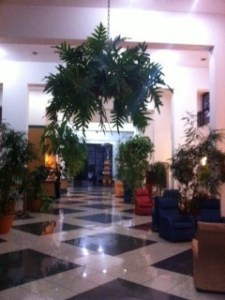
Hotel Jugau Cuba

The Emerald Hummingbird mother (photo by Alexa Halpern)

The Emerald Hummingbird mother (photo by
Alexa Halpern)

Mother feeding her young. (photo by Alexa Halpern)
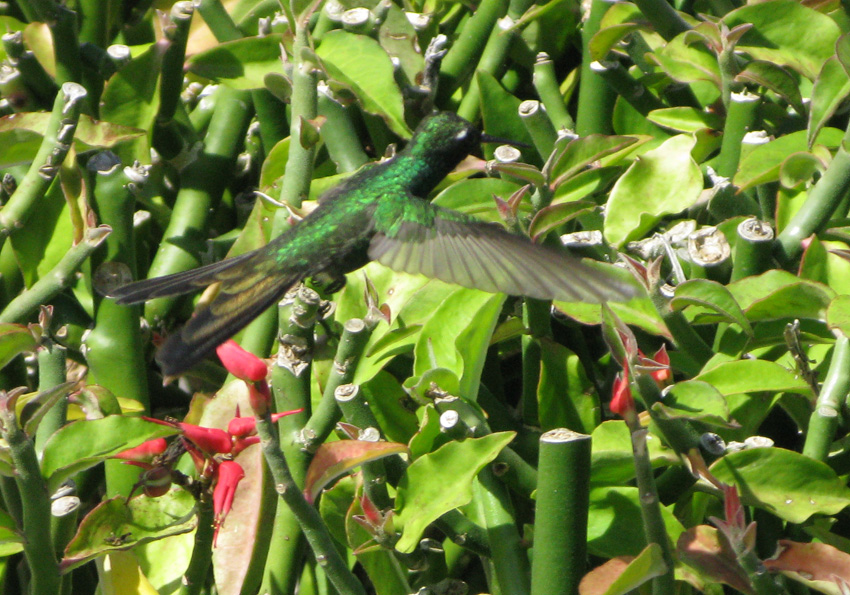
We also saw an Emerald hummingbird at the Bay of Pigs.  His green iridescent feathers were a sight to behold!  Like other species of birds, the male Cuban emeralds are more colorful than the female and smaller.  Hummingbirds are the only birds that can fly backwards and their wings flap about 15 to 80 times per second.
Hummingbirds are an integral part of pollination because they sip nectar from many different flowers in one day.  They bring pollen from flower to flower while getting the nectar.

I was looking to see the Emerald Humming Bird’s smaller cousin, the Bee Hummingbird, the smallest bird in the world, but we did not see one.

Male Emerald Hummingbird ( photo by Lyn Roger)

Male Emerald Hummingbird
Behind the leaf, you will see the thin pointed beak used for gathering nectar.
( photo by Lyn Roger)

Humming bird at the Bay of Pigs (photo by Lynn Roger)

Hummingbird at the Bay of Pigs (photo by Lyn Roger)


2013 SUMMER INSTITUTE FOR PHILADELPHIA AREA SECONDARY TEACHERS

Secondary school math, physics and physical science teachers

are invited to apply for atwo-week summer institute

 July 8 – 19, 2013 at Bryn Mawr College

Math, Computing and Sustainability:

Helping to Make a Green Ribbon School

The institute is sponsored by Bryn Mawr and Haverford Colleges with financial support from the Howard Hughes Medical Institute. As part of the Institute, there will be a one-day workshop for school administrators, facilities professionals and teachers on: Green Ribbon Schools Workshop: Linking Facilities, Operations and Curriculum  Program Outline: Participants in the program will learn new content related to math, computing and sustainability and will then develop and implement plans for putting their new learning into practice in their classroom over the coming year. Participants will also develop plans to engage students in hands-on projects to green their school and community. Program Benefits: Participants who successfully complete the summer institute will receive 60 hours of Act 48 credit and a $500 stipend. Eligibility: Secondary (high school and middle school) math, physics and physical science teachers are eligible. Preference will be given to teams of teachers from the same school. A successful team will also include a facilities professional from the school/district who agrees to attend the one-day workshop on greening operations that will be held in conjunction with the Institute. Institute enrollment will be limited to twenty participants Application Procedure: Information about applying including the on-line application form will be available starting on Monday March 18 at the institute website: http://serendip.brynmawr.edu/exchange/sustainability/institute Application deadline will be Wednesday May 15th. The institute will be directed by: Victor Donnay, Professor of Mathematics, Bryn Mawr College and John Dougherty, Associate Professor of Computer Science, Haverford College Contact: Kate Heston, Haverford College (kheston@haverford.edu)  

Compact Fluorescent Light Bulbs in Cuba

This article is one of a series based on my trip to Cuba. I traveled on a People to People tour to Cuba called: Cuba Today, People and Society with Road Scholar. www.roadscholar.org

CFL Light Bulb

CFL Light Bulb

On my recent trip to Cuba I noticed that every single lamp had  compact fluorescent light bulbs. (CFL)  Everywhere I went I saw them: every restaurant, school, bathroom, hotel room, church, museum, synagogue, opera house, bar and private home.  Every. Single. One. Facing an energy shortage in the late 1990’s the Cuban government decided to replace all incandescent light bulbs in Cuba with CFL bulbs.  The Cuban government financed the plan to install millions of compact fluorescent light bulbs in 2.7 million households and institutions.  This was done to deal with the serious electricity capacity and fuel constraints facing the island nation.  It was decided that changing the light bulbs was cheaper than producing more energy.  By 2000 mostly every lamp in Cuba had compact fluorescent light bulbs installed.  Refrigeration, air conditioning (or water heating) and lighting are the three principal uses of electricity in Latin America.  Lighting is usually a major contributor to the evening peak electrical load.  Replacing incandescent bulbs in Cuban lamps proved to be a less expensive alternative than supplying more energy to meet electrical demand. CFLs are energy efficient light bulbs that are an alternative to incandescent bulbs.  The CFL costs a bit more, but they can pay for themselves in power bill saving.  (In the case of Cuba, the government subsidized the replacement of 11 million bulbs.)  Incandescent bulbs emit light when an electrical current is passed over a filament that glows.  This kind of bulb casts a gentle glow, but loses a lot of its energy to heat.  Fluorescent bulbs emit light when an electrical current energizes the argon and mercury vapor inside the tube.  The phosphor coating inside the bulb is then excited and the bulb glows. Much less heat is emitted this way and a lot less energy is consumed. One-fifth to one-third less electrical power is used in a CFL bulb and they last eight to 15 times longer. The savings can be significant over time. One complication of the use of CFLs is their disposal.  Since they contain mercury, proper disposal is an issue.  If the bulb is kept in tact then there is no risk of mercury escaping, but if it is broken, then the mercury inside the bulb could pose a problem.  In this country, several states have guidelines as to disposal of the CFLs.  The EPA has established methods for disposal including recycling. In Philadelphia, Cohen Hardware at 615 Passyunk Ave, 215 922 3493, will accept old CFL light bulbs for recycling.     (http://cohenandcohardware.com/index.html).  Your local Whole Foods store will also recycle CFL bulbs. Let’s hope the huge effort in Cuba to replace incandescent with fluorescent bulbs included guidelines for disposal. Recycling is everywhere in Cuba, specifically out of necessity.  Very little goes to waste because the Cubans have very little to begin with.  But I couldn’t find any mention of CFL bulb recycling in Cuba to ease my concern that 11 million mercury-containing bulbs might someday be found in a landfill.

Love In the Zapata Swamp

This article is one of a series based on my trip to Cuba. I traveled on a People to People tour to Cuba called: Cuba Today, People and Societywith Road Scholar.  www.roadscholar.org


Title

Cuban crocodile

There is so much we Americans don’t know about Cuba.  On my recent trip there I traveled by bus through the Zapata Swamp on my way to visit the Bay of Pigs.  I never heard of the Zapata Swamp, nor did I know about the fascinating biology that is going on in this expansive wildlife refuge.  Inter species breeding is occurring between the rare Cuban crocodile and the North American crocodile, and the offspring are fertile. I thought it could not be true, until I did a little research. Here is what I found out: Scientists knew that Crocodylus acutus (the American crocodile) has mated with Crocodylus rhombifer (the Cuban crocodile) in zoos.

None

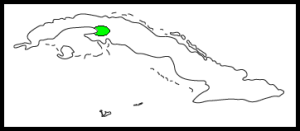
The Zappata Swamp is in green.

But recently scientists in Cuba did genetic testing in the wild to confirm that this interbreeding is happening in the Zapata Swamp. The interbreeding might satisfy the “needs” of the crocs, but it is one factor contributing to the decline and possible extinction of the Cuban crocodile. It is estimated that the genetically pure Cuban crocodile’s population is down to 3,000 individuals.  The interbreeding is reducing the number of Cuban crocodiles. From the 1850’s through 1960, the species was drastically reduced due to hunting. Apparently, American crocodiles living in Cuba are related more closely (genetically) to Cuban crocodiles than to American crocodiles living on mainland Central America.  This closeness has allowed the hybridization to occur. Researchers found a 1 percent genetic sequence divergence between Cuban crocodiles and American crocodiles in Cuba. They found an 8 percent divergence between American crocodiles in Cuba and other American crocodile populations living in mainland Central America.  These finding reinforce the statement that American crocodiles in Cuba are more closely related to Cuban crocodiles than other American crocodile populations. According to scientists this kind of inter breeding can naturally occur in isolated species. According to Judith Rhymer (University of Maine) and Daniel Simeberloff  (Florida State University)1:  “Some degree of gene flow is a normal, evolutionarily constructive process, and all constellations of genes and genotypes cannot be preserved. However, hybridization with or without introgression* may, nevertheless, threaten a rare species’ existence.1”   *Infiltration of the genes of one species into the gene pool of another through repeated backcrossing of an inter specific hybrid with one of its parents. To learn more about the Cuban crocodile I recommend this video and website: http://youtu.be/JUEcx900MDg http://today.ttu.edu/2011/12/cuban-crocodile-research-leads-to-500000-year-old-discovery/ 1EXTINCTION BY HYBRIDIZATION AND INTROGRESSION Annual Review of Ecology and Systematics Vol. 27: 83-109 (Volume publication date November 1996)

SPRING INTO SCIENCE–SAVE THE DATE (MARCH 4)

SpringintoScienceEducation2013

The 3rd Annual Spring Into Science Education Expo is March 4 in collaboration with the Philadelphia Math + Science Coalition.

Spring Into Science  is a celebration and networking event for local educators. This year there will be:

  • screenings of EcoExpress.org’s documentaries
  • environmental, science and math experts present
  • hands-on-learning demonstrations
  • refreshments and more

Monday, March 4, 2013

4:30 to 7:00 pm

at the United Way Building

(1709 Ben Franklin Parkway, Philadelphia Pa.)

Register for free at:

http://ecoexpress.eventbrite.com

New Year’s Resolution: Eating Local

This article is one of a series based on my trip to Cuba. I traveled on a People to People tour to Cuba called: Cuba Today, People and Society with Road Scholar.  www.roadscholar.org

Organic Farm in Havana

Organic Farm in Havana

My New Year’s Resolution is to try to buy local produce and foods that are grown close to home. Purchasing food grown locally strengthens regional economies, supports family farms, provides delicious, “fresh-from-the-field” foods for consumers, preserves the local landscape, and can help foster a sense of community.  It also requires less energy consumption for refrigeration and transport. The inspiration for me to do this comes from the Cuban people. I went to Cuba last month. While there I learned that organic farming is huge on the island.  This happened by necessity.  The Cubans found themselves facing a food shortage in what they call their “special period”–the time in the early 1990’s when the Soviet Union dissolved and suddenly pulled out support to Cuba. Cuba lost 85% of its agricultural imports, foreign trade and petroleum.  Add to this the crippling effects of the U.S. embargo and the country’s food supply was hit very hard.  By necessity Cubans began growing their own food in urban gardens without pesticides or herbicides, mainly because there were none available.  The result was an increase in people in Havana and other cities growing organic food and eating locally.  The organic farming movement is evident everywhere. In America, eating organically and buying organically grown foods is still not mainstream and often very expensive.  But in Cuba it is the norm.  Cuba has one of the most successful and highly educated farming communities in the world.In Havana there are 8,000 gardens that produce broccoli, tomatoes, cabbage, lettuce, onions, bok choi and radishes.  With limited gasoline for transportation and refrigeration to bring food from the countryside, food production occurs in the cities. Local residents are planting food in every conceivable corner of Havana. Sadly, about three buildings a day collapse in Havana due to neglect and a crumbling infrastructure.  When a building collapses, the community clears the rubble, and plants a garden. Cuba’s government is supporting the organic food movement.  It is a model of what can happen if a government decides to put its energy behind non-toxic agriculture. Scientists there have developed biological pesticides and fertilizers putting Cuba way ahead of the rest of the world in the area of organic farming. Some of the techniques used by Cuban gardeners are traditional ones, such as the use of worms. Red worms are used to produce worm poo as the worms feed on kitchen scraps.  This worm waste is then applied as fertilizer.  It is high in nitrogen and is quickly accessible by crops.  Another technique is inter-planting.  This technique discourages pests because diverse crops are planted together, thus discouraging bugs from feasting on the single crop planted in a garden.  Cuban gardeners are also very good scientists.  They observe problems in their gardens and apply scientific methods of observation and trial and error to trouble shoot problems when they occur.    For example if a gardener is having trouble with aphids, the farmer might wash the plant and then observe if wasps or lady bugs show up a few days later. They then analyze what happened and apply new techniques. The result is that Cuban people are eating better than before.  About twenty years ago, food was so scare people were on the brink of starvation. But now, some individuals are even making a living growing vegetables, and doing so with the government’s blessing. The social and economic benefits of growing and buying local are being realized.  But there is one more amazing situation that has occurred.  Inadvertently, the communist government, along with the US embargo and the withdrawal of Russian support has made Cuba’s coral reefs the best in the world. This is a result of the strict limit on the availability of fertilizer and pesticides.  By not using such toxins, fresh water that flows to the sea from Cuban soil does not contain nitrates and other harmful chemicals.  In other parts of the world, coral reefs have been severely compromised by such runoff, but the levels of pollution are so low off the coast of Cuba, the coral is thriving. For more information about this “accident” watch the PBS episode of Nature called, The Accidental Eden http://www.pbs.org/wnet/nature/lessons/reef-madness/enhanced-video-resource/7397/

34th Annual George Washington Carver Science Fair Needs Judges

carvermedalsmallThe George Washington Carver Science Fair Committee  invites you to serve as a judge at the 34th Annual George Washington Carver Science Fair.  The Carver Science Fair encourages urban youth to pursue academic achievement, careers in science, civic involvement, and character development. Jointly sponsored by The School District and The Archdiocese of Philadelphia, Temple University, and the Academy of Natural Sciences, the Fair is open to all Philadelphia public, charter, parochial, and private school students in grades four through twelve. Since its inception in 1979, over 30,000 students have participated in the Carver Science Fair and have, in many cases, moved on to compete in the Delaware Valley Science Fair. As in previous years, the judging day includes a continental breakfast, a brief introduction to the fair, project evaluations through the morning, a buffet lunch, the opportunity to network with colleagues, and individual student interviews throughout the afternoon. Judges also receive free parking. The dates, times, and locations of this year’s judging activities are:

Grades 4 through 6

Wednesday, February 20, 2013 from 8:30 AM to 4:30 PM

The Academy of Natural Sciences, 19th Street and Benjamin Franklin Parkway

Grades 7 through 12

Tuesday, March 12, 2013, from 8:30 AM to 4:30 PM

Temple University, Broad Street & Montgomery Ave.

If you can serve as a Carver Science Fair judge on either or both of the Fair dates, please visit the Internet link below and complete the on-line judge’s registration form under the judges information section. You will receive an electronic confirmation and further details as the Carver Science Fair approaches.       http://www.temple.edu/carversciencefair/carverjudges.htm

If you know of other individuals who might like to participate as judges, please forward this web site to them.  The Carver Science Fair continually seeks to expand its pool of eligible and available judges. A science fair judge need not be employed in a science or education field, but should possess a comfortable background in science, math, technology, engineering, and/or education as well as have an appreciation for science education.

 For additional details or information, please contact Dr. Kathy Fadigan, Judges Chairperson, at kfadigan@temple.edu.