December 2, 4:30-6:45. To register RSVP BY November 27 at noon to: dmckinney7@verizon.net Include your school, the grade(s) and the subject(s) you teach. Dinner is included. FREE! SCHOOL DISTRICT OF PHILADELPHIA TEACHERS WHO ATTEND WILL RECEIVE ACT 48 CREDIT. All math and science teachers, grades K-12, in Philadelphia are welcome. The Forum is held at the United Way Building, 1709 Ben Franklin Parkway. PARKING: Sheraton Hotel for $5 for three hours. The Sheraton is located between Race and Vine, with entry to the garage from either 16th St. or 17th St. Science: Science and Literature (K-4th grade) Presented by Anita Brook Dupree of Science Is My Specialty. Teachers will read the children’s book “Make Way for Ducklings” and create science lessons based on the story. Teachers will learn about characteristics of birds, bird behavior such as preening, perform simple experiments about birds, observe bird bones and feathers, learn how to make 3 dimensional graphic organizers called Foldables ™ and record findings in Science Notebooks. Science: Inquiry and Literacy, Inseparable in the Elementary Classroom presented by Susan Holmes Together we will dive into an investigation of a common material and a phenomenon it frequently exhibits. Then we will connect it to a book that at first seems unrelated, reflect on inquiry and the elementary student, share classroom strategies and explore other ways to think about incorporating literacy seamlessly into science learning. Susan Holmes will present. You know her from 20 years at the Franklin Institute, but she is now working with the NJ Academy for Aquatic Sciences at Adventure Aquarium. Please update her contact information! susan.holmes.0@gmail.com or phone: 610-623-7692. Math: Bringing Research into the Classroom: Addressing Misconceptions with Worked Examples presented by Karin Lange The use of worked example problems, not to be confused with working out an example, gives students and teachers an opportunity to do math in a different way by showing students a completed problem and asking them questions to deeper their understanding of mathematics. This idea has been researched in classrooms and has shown increased learning. Also aligned with the Common Core, these strategies can be applied to any topic in your own classroom! The majority of research has been completed in Algebra 1 classrooms, though time will be devoted to discussing how this strategy can apply to elementary, middle, and higher level mathematics as well!
Author Archives: abdupree
Elves as Environmentalists in Iceland
 Science Is My Specialty recently travelled to Iceland to experience the geology of this fascinating land. This is the first in a series of blogs about the trip.
In the next few weeks we will see images of cartoon like elves everywhere here in America. It will be unavoidable. They will appear in print and TV ads, in movies, and in the theater in productions such as the musical Elf. They will appear on holiday cards and wrapping paper, and there might even be elf impersonators at your local department store, hanging out with Santa. If you think elves are big here in the United States, you must visit Iceland and ask any Icelander about them. The American elf that we see this time of year is very different from how people in Iceland depict them. They describe them as looking and living like humans, with houses and churches, and whole societies with cattle and farms often inside rocks and cliffs. Icelandic elves have magical powers and can be nice or mean, depending on the situation. They are known to be mischievous and if something goes missing, Icelandic people often blame the elves. On my trip to Iceland I asked my tour guide about the elves that are reported to be living there. He explained that while many people don’t truly believe they exist, they do feel there is a place for them in Icelandic society. Icelandic parents tell their children stories about elves. Recent studies report that about 10% of the Icelandic population believes that elves exist and about 80 % “take notice” (and about 10% are staunch non believers). However you look at the numbers, the stories about elves are part of Icelandic society. Academics that study the folklore of Iceland have come up with a few theories as to why elves have such a place in Iceland. They say that when the Vikings arrived in Iceland over 1000 years ago there were no indigenous populations there. All Icelanders are descendants of Vikings (and the Scotch and Irish) who settled the land. In order not to feel so isolated, the settlers believed that elves (and trolls—giants) inhabited the island. It is not hard to image the Huldufolk (hidden people as they call them) darting around in the lava fields. The rock formations, the shadows at dawn and dusk and the desolate isolation can make natural landforms look like human forms. There is an eeriness to the landscape in Iceland that is conducive to a vivid imagination. The folklore associated with elves lives on and probably one of the most important roles that the elves take on is that of environmentalists. Iceland is a country of true beauty. It is unmarred by advertising signs, population growth and careless industrial development. Most of the country is still pure and pristine, with most of the population living in the capital city of Reykjavik. The Icelandic people place a high priority on environmental issues. They do not like to disturb nature for unnecessary reasons, and often the stories about elves represent a special connection to the environment and natural landscape that is otherwise difficult to explain. Iceland is a land of volcanoes, lava flows, high winds, glacier movement and shaking ground from earthquakes. The people have to give in to and embrace nature. 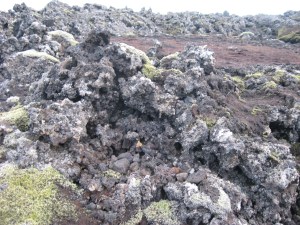 The strong belief of the possibility of elves actually works in favor of the environment. In a town about 10 minutes drive outside of the capital, a group of people from a civic organization called “Friends of the Lava” met with the Icelandic Road and Coastal Administration and members of the governing board of the municipality of Garðabær. They met to discuss a new road development that would cut through the landscape to install a traffic circle and provide a more direct route from town to the tip of the peninsula. The “Friends of the Lava” protested the road development because it would destroy “amazingly beautiful lava formations” and spoil a habitat where birds flock and small plants flourish. Others said the road “will displace certain supernatural forces that dwell within the hallowed volcanic rubble, and fear the potentially dark consequences that come with such a disturbance.” They believed that elves live there and it is not a good idea to disturb their home. Some people say that if a road development is truly necessary then the elves don’t mind. But if it is not, that is when problems can occur. As of October 30, 2013 the new section of road was not built. The local council is still deliberating and the issue is going to a high court. No matter how you view the story of elves in Iceland—fiction, fantasy or a story to tell your children to perpetuate the culture– the stories behind the elves significantly contribute to how people in Iceland care for the environment. They do not want to take the chance of upsetting the elves, so they take preservation of the environment seriously. There seems no reason to begrudge the Icelanders in their elf-belief. It doesn’t seem to be hurting anyone and it certainly is interesting! To read more about this topic go to: http://www.theatlantic.com/international/archive/2013/10/why-so-many-icelanders-still-believe-in-invisible-elves/280783/
Meleagris gallopavo: The Domesticated Turkey
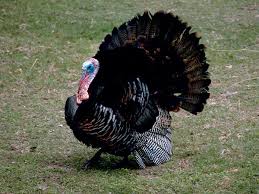 Most of us will eat turkey this month (95% of all Americans eat turkey in November), and it seems only fitting to know some facts about this important bird in our culture. The bird we eat today is a descendant of the wild turkey that roamed North American when the European settlers arrived. There are some differences between the domesticated turkey we eat today and the wild ones. Wild turkeys can fly, but domesticated turkeys cannot. Also, wild turkeys have dark feathers while domesticated turkeys are bred to have white feathers. Domesticated turkeys have been bred to have large breast muscles (more white meat for us). Many people assume the large 20 pound turkeys found in grocery stores are a result of hormone injections or some other artificial means to get the turkeys so big. But actually synthetic hormone injections were banned in turkeys in the 1950’s. Today’s big turkeys are a result of selective breeding. Turkeys with larger breast muscles are bred with each other , passing those genes to their offspring. Additionally, the turkeys are fed a diet that helps build muscle. I am thankful that today’s turkeys are larger because they are free from the cancer causing synthetic hormone diethylstilbestrol! However, you still might want to look into buying a turkey from a vendor that claims to grow turkeys organically and humanely. The common turkey bought in the large grocery stores is probably a turkey that was so fat it couldn’t mate and had to be inseminated artificially. In addition, often the mother turkey is never in contact with her young, so the young chicks never get a chance to pick up survival skills or behaviors. These domestic turkeys are totally dependent on the breeders. If you are in the Philadelphia area you might check out Reading Terminal or this website to search for an organic, humanely bred turkey. https://fairfoodfarmstand.myshopify.com/
Riverbend Environmental Education Center Seeks Input on Aquaponics Program
Riverbend Environmental Education Center, located in Gladwyne, teaches environmental principles through a direct connections with nature, inspiring respect for our natural world and action as aware, responsible and caring citizens. Riverbend is currently developing an exciting new educational initiative, a self-sustaining Aquaponics program. In 2014, we will be building a 4,380 square foot greenhouse to grow crops that will be distributed to local markets and restaurants. In keeping with our educational mission, we will offer a variety of programs around Aquaponics and sustainable agriculture. In order to develop programs that will best serve the needs of the community, we invite you to participate in a short survey regarding topics and types of programs that most interest you. Please feel free to pass this survey on to others, the more feedback that we can get the more relevant the programming can be. Thank you so much for your time and participation! Click here to take the survey (takes less than 5 minutes): http://survey.constantcontact.com/survey/a07e84g7gr5hl6lc56s/start
“The How-To’s of Doing Student Science Research”
“The How-To’s of Doing Student Science Research” will take place from 4-6 PM on October 28, 2013. It will be held at the School District of Philadelphia Administration Building, at 440 N. Broad Street, in Room 1072.
Ruth Patrick, Stream Biologist Pioneer, Dies at 105

Ruth Patrick, stream biologist pioneer, dies at 105
Dr Patrick was an ecologist who worked at the Academy of Natural Sciences for 8 decades. She died Monday at the age of 105. Dr. Ruth Patrick devised a system to gauge the health of a stream by studying the biological diversity in it. She was an expert on diatoms (single celled organisms) and discovered that the presence or absence of diatoms, certain insects and macro invertebrates were all indicators of stream health. Ruth Patrick was the first person to realize that we can measure the extent to which conditions have affected a stream by observing the number and type of organisms living in it and relating that information to the surrounding habitat. In order to determine the richness of the living community, scientists observe changes in the total number of organisms. Different species react to pollution in different ways. Organisms that are pollution-sensitive are more susceptible than others to the effects of changes in a stream. Organisms that are pollution-tolerant can cope with adverse conditions more easily. The presence or absence of such organisms is an indirect measure of pollution. When a stream becomes polluted, pollution-sensitive organisms decrease in number or disappear, while pollution-tolerant organisms remain stable or increase in number. We can thank Dr. Ruth Patrick for this discovery. For more information about Dr. Patrick’s life, check out the memorial article about her at: http://www.ansp.org/about/academy-news/archive/2013/September/ruth-patrick/
Birds in the City
 Many of us are so used to just seeing pigeons and sparrows in cities that we don’t even think other birds live in an urban setting. But this is not true. On a recent trip to visit my daughter in Brooklyn New York, we sat in her yard and watched Northern Cardinals (Cardinalis cardinalis) visit her bird feeder. I then found out that Northern Cardinals can be found in Philadelphia and most east coast cities. We really wanted a picture of them, but they did not want to be photographed! The minute we raised our cameras to take a picture, they flew away. The male Northern Cardinal is the member of the species that is most beautiful. (In nature, often the male is more colorful). The red feathers are distinctive even in winter because they don’t migrate and they don’t molt into dull feathers. They can be seen vividly against the white of the snow. The brown females have a short crest and red accents in their brown feathers. The Northern Cardinal likes dense shrubby areas and will visit your backyard if you put up a bird feeder. They look for fairly high perches for singing. Both male and female Northern Cardinals sing. In summer, their whistles are one of the first sounds of the morning. To hear the sound of the Northern Cardinal: http://www.birdjam.com/birdsong.php?id=3


In Janine’s garden, waiting for the cardinal. Photo by Janine Dupree
BIO RETENTION ISLANDS—NOT JUST A PRETTY FACE
 I am happy to say that on a recent visit to San Francisco I noticed bio retention islands in parking lots in the Bay Area. I have noticed them recently in the Philadelphia area too. They are nicely landscaped, and they are the kind of commonplace thing you see that you don’t “really” notice. Often they blend in with the environment well. This is a good thing. But recently I began noticing them more and wondering what are they and why are they there? I recently learned that they are not just there for ornamentation. They are there to manage storm water that flows over impervious surfaces such as parking lots. Bio retention areas are landscaping features that are built to provide on-site treatment of storm water runoff. Surface runoff is directed into shallow, concave depressions. These depressions are designed to incorporate many storm water management practices. During storms, runoff gathers above the mulch and soil in the system. The remaining runoff filters through the mulch and soil mix. The runoff is collected and stored in the soil, or it is directed to perforated “under drains” and then returned to the storm drain system after the rain event has occurred. All of this results in reducing the amount of untreated storm water run off that is directed into storm drains and ultimately into rivers and streams. BIO RETENION ISLANDS IN BURLINGAME, CALIFORNIA. LUCKILY, WE SEE A LOT OF THESE APPEARING IN THE PHILADELPHIA AREA
Do You Know About the Philadelphia Teacher Residency?
You are invited to help tackle a pressing national and global challenge:
The need for well-prepared math and science teachers in our classrooms. 
Do you know about the Philadelphia Teacher Residency Program? Philadelphia Teacher Residency is a teacher preparation program for professionals and recent graduates who want to teach math & science in Philadelphia’s high need schools (Grades 7-12).
1) They select the best and brightest student teachers to enroll in the University of Pennsylvania and Drexel Graduate Schools of Education. Teachers enter a one-year residency program (similar to a medical residency) and are then immersed in the classroom alongside a network of skilled mentors and program administrators. 2) Student teachers (Residents) work alongside a mentor teacher for a full year (more than 1000 hours of clinical experience). 3) Residents receive job placement assistance and support with integrating into Philadelphia Public Schools.

PTR collaborates and shares best practices with other teacher residency programs across the country-a significant benefit! In addition, those enrolled in the program earn a Master’s Degree and teaching certification prepared for first year classroom teaching.
Are you already teaching in Philadelphia? Would you like to improve math & science classroom teacher excellence and help with teacher preparedness? We are currently looking for mentors. (A stipend is provided to mentors). For more information, please contact Dr. Carol Rulli or visit PhilaEdFund.org.
One of the Most At Risk Animals in North America
 Some of the most at risk animals in North America might appear to look like a rock at the bottom of a creek. You might walk past them, not necessarily because they are scarce but because they blend so well into their surroundings. The animal at risk is the freshwater mussel! Over harvesting for bait, loss of fish needed for reproduction, reduction of forests along streams (the trees cool the water), toxic spills, the building of dams and polluted water have all played a role in the decline of the freshwater mussel both in species diversity and numbers of animals. No matter what the cause, a stream without mussels is at a serious disadvantage. Mussels strengthen streambeds by keeping the bottom soils in place and provide food and habitat for other animals and plants. Mussels are “filter feeders” so they clean water. They suck in water, trap dirt, algae, and other pollutants and then release the filtered cleaner water back into the stream. One mussel can filter several gallons of water each day. Freshwater mussels need our help because there are over 300 species of freshwater mussels native to North America. Close to 75% are defined as of “concern” by state and federal governments and many are listed as endangered or threatened. If you live in or around the Delaware Estuary and you would like to help protect freshwater mussels contact the Partnership for the Delaware Estuary: http://www.delawareestuary.org/Mussel-Survey-Program
 Science is My Specialty
You must be logged in to post a comment.