 On a recent trip to Boston, I found myself with a free day and no specific plans. Someone suggested a trip to Concord, Massachusetts and Walden Pond.
It’s been decades since I first learned about Henry David Thoreau and his two years in the woods. How exciting it was to visit the area where he wrote Walden in 1854.
In addition to being known as a philosopher, writer and abolitionist, Thoreau is considered one of the first environmentalists with his many philosophical contributions to the way we view nature. Thoreau was interested in people’s relationship with nature and studied this by living close to nature in a simple life. He published his experiences in the book Walden that argues that people should become intimately close to nature. He felt that the physical environment inspires us. He wrote in his poem “Walking”: “I wish to speak a word for Nature, for absolute freedom and wilderness”
Fast forward to modern times and think about the book “Last Child in the Woods” by Richard Louv, where he states that humans, and especially children, are spending less and less time outdoors. Louv contends that lack of being outdoors might be contributing to behavior and attention deficit disorders. Could Thoreau ever have imagined the electronic devices that draw children to be indoors? Could he even consider the fears parents often have of letting their children run free outside?
Consider an afternoon hike in the park or building in the outdoors into your daily routine. Here are a few reasons you should go outside
- Improved short term memory
- Restored mental energy
- Stress relief
- Improved concentration
- Sharper thinking and creativity
Click here for more information on each suggestion.
 In early October I visited Erie Pa. to sit on a panel about Climate Change at an event called the Community Resiliency Summit. The summit was hosted at the Tom Ridge Environmental Center,
  Since ancient times people have been adorning their homes with holly, evergreen trees and ivy in December. During the cold dark days of winter, much of the landscape is dreary, but certain varieties of plant life remain green year round. Some also produce bright red berries bringing a bit of cheerful color to an otherwise bleak landscape. In order to get a sense of happiness and a hope for the future joys of spring, people began to bring in these evergreens into their homes. So how do evergreens stay green? Evergreen shrubs such as holly face many challenges during winter. Actually, cold temperatures are the least of the plant’s problems. Photosynthesis can occur in many plants when temperatures are at or a few degrees below freezing. The biggest problem for plants in winter is drying out. When the ground freezes, plant roots are unable to draw liquid water from the soil. Then the plant becomes dehydrated, and the plant cell membranes lose their shape and rupture, killing portions of the plant. Cell tissues can also die if ice crystals form inside cell membranes. In order to combat drying out, holly plants, evergreens and certain ivy have tough leathery leaves that are resistant to drying out. The thick waxy covering of the leaves allows the plant to live through the winter. Also, evergreen trees have needle-like leaves instead of broad flat leaves. This shape helps conserve any water that remained from the warmer weather.
 When you think of October, you think of pumpkins! We will have pumpkins to carve this month and pumpkins to eat in pie next month. Pumpkins are so prominent during October and November we hardly give their back-story even a thought.
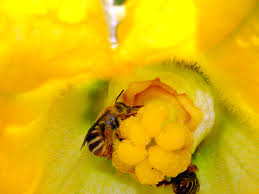
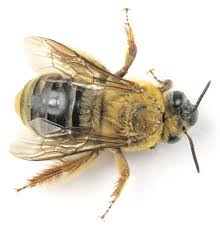 THE IMPORTANCE OF BEES
 While cycling 140 miles last week on the C and O Canal, I had lots of time to think. The trip took me 4 days, and it was quiet and peaceful. Most of the time the only evidence of civilization was other riders or hikers, the occasional airplane overhead or the sound of a railroad train in the distance. Otherwise it was like being alone in the forest. The trail, which runs parallel to the Potomac River, was constructed as a towpath along the Chesapeake and Ohio Canal to pull barges filled with lumber, agricultural products and coal, down the canal to market. The almost flat towpath goes from Cumberland Maryland to Washington DC. The C & O Canal is full of natural scenery and wildlife. I saw a herd of deer, a few snakes, Blue Herons, a Bald Eagle, some vultures, a fox and countless turtles. It was the turtles, lounging in the sun at one of the many locks along the way, that made me think about the truth about being cold blooded. Those turtles were in the sun to keep warm, not because their blood is cold, but because animals that are “cold blooded” take on the temperature of their surroundings. If it is warm outside, they are warm. If it is cold they are cold. A warm-blooded animal, such as the deer and fox I saw, maintain a steady body temperature, despite the temperature of their surroundings. If it is cold outside, or if it is warm outside, these “warm blooded “ animals maintain a steady temperature through metabolic means. warm-blood·ed (adjective) Relating to or denoting animals (chiefly mammals and birds) that maintain a constant body temperature, typically above that of the surroundings, by metabolic means. Also known as homoeothermic. cold-blood·ed (adjective) Relating to animals (mainly fish, amphibians, and reptiles) having a body temperature that changes according to the temperature of the surroundings Also known as poikilothermic.
 Have you noticed the shape of most bicycle helmets? There is a lot of science that goes into those helmets. They are designed to be aerodynamic and lightweight. They are also designed to protect the head if you should fall. Helmets have a hard outer shell and a softer inner lining. The hard outer part is designed to absorb the force of impact over a larger area, so as not to cause a concussion. The soft inner part is designed to absorb any energy that might occur upon impact. Interestingly, scientists are looking at the complex skulls of woodpeckers to figure out ways to make even better crash helmets for humans. A woodpecker strikes a tree about 1,200 times a day at a speed of about 14 miles per hour, and never sustains injury. Woodpeckers have four components that help them from getting concussions: an elastic layer supports the tongue, which stretches around the skull beneath the skin, their beaks are flexible, yet solid and strong, a spongy bone separates the woodpecker beak from the brain (in order to dampen the force of pecking), and there is a thin fluid-filled space between the skull and the brain (to minimize transfer of vibrations) Keeping in mind what they have learned from the woodpecker, scientists and industrial designers are suggesting utilizing components of the woodpecker head to come up with enhanced and safer ways to make helmets. One British industrial designer from London’s Royal College of Art, Anirudha Surabhi, has designed a super strong helmet he calls the Kranium that helps protect cyclists’ heads by mimicking features of the woodpecker’s anatomy. He has used an unlikely material for the inner liner of the helmet: a special dual density cardboard with a honeycomb structure. This material beat out other contenders in his laboratory trials. The cardboard inner liners are durable and quite easy to produce, and has its roots in the design of the woodpecker head. The Kranium helmet is now on the market and available for purchase for about $130.00. The next time you need a solution to a problem, the answer might just be in nature’s design. Check with Mother Nature first before you begin!
 Science is My Specialty
You must be logged in to post a comment.