Reduce, Reuse and Recycle

Reduce, Reuse, and Recycle.  These three words can be heard resonating through school classrooms as teachers try to instill a sense of stewardship for the planet by encouraging students to use less, fix instead of replace and to recycle their cans, bottles and paper.  I often wonder however if students have any idea about exactly how recycling works.  A trip to a recycling plant would be fabulous, but probably impractical for most teachers.  I suggest teachers have students make their own recycle paper to learn how we can use used paper to make new paper. THE SCIENCE BEHIND THE PAPER MAKING Paper has been used in China since before 105 A.D. and some archeologists believe paper was used 200 years before this. The cellulose fibers in wood are the primary source for paper.  These fibers are held together by a kind of glue that has to be extracted by tearing or shredding.  Modern day papermaking employs the use of a kind of blender that shreds and tears the wood (or recycled paper) into a pulp when it is mixed with water.  Sieves are used to extract the pulp and leave the water behind. As the paper dries, the cellulose fibers are glued back together and a new sheet of paper is formed. MAKING YOUR OWN PAPER MATERIALS

  • wooden frame
- sieve with holes of about 1 mm (available in a hardware store)flat sponge
  • water
  • scraps of paper
  • absorbent squares for drying: felt, cardboard, newspaper
  • plastic tubs or trays

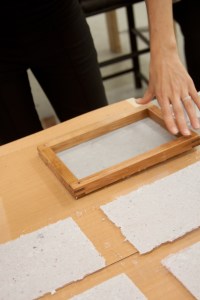
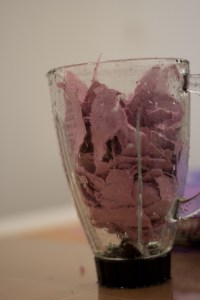
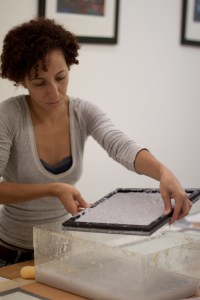
WHAT TO DO: Ask your students to search in their book bags for old assignments, letters from the teacher, hand out sheets from months ago etc., and have them begin to tear the paper in small bits.  Take pieces of the paper and put it in the blender. Add water to cover and whirl it around until a smooth pulp is made.  Pour the pulp into the plastic bin and add more water if it seems very thick.  Take your wooden frame with the sieve mesh and lower it below the pulp.  Bring up the screen slowly as the water drains out.  Take the cardboard or other absorbent material and place it under the sieve.  Use the sponge to soak up excess water.  Slowly and carefully lift the sieve. Leave the pulp to dry over night.  The paper will be dry in a day or two.
untitled__110918_IMG_3509
untitled__110918_IMG_3514
Add water and blend into a pulp.
untitled__110918_IMG_3522
Place pulp in trays and add more water.
untitled__110918_IMG_3507
untitled__110918_IMG_3553Use screens to gather up pulp and sieve out water.
The paper will dry in a few days.

 Photographs by Janine Dupree Photography

10 Ways to Improve Scores on High Stakes Science Tests

The NCLB (No Child Left Behind) law mandates that schools must administer annual tests in science achievement at least once in Grades 3–5, 6–9, and 10–12. Current U. S. Department of Education guidelines do not count science test scores as part of the Annual Yearly Progress calculations, so science is not in the limelight like math and reading. A recent survey done by NSTA (National Science Teachers Association) asked members if they thought science should be counted towards AYP. They found that 63% of the 600 people who responded are in favor of counting the science tests in AYP. Reasons in favor ranged from “otherwise why test and gather data?” to “science is the language of life”, while others called for adding science to AYP in “hope of raising its importance” among educators, parents and students. Those who oppose stated the same thing from a different view saying “inadequate resources are devoted to science, making the testing unfair.” In September President Obama unveiled a sweeping plan to give states some flexibility under the federal No Child Left Behind (NCLB) education law. It is yet to be determined how this will affect science testing in each state. Until we know exactly how this will play out in each state, high stakes test in science are still being given. I have suggested my top ten ways to improve these test scores.

  1. Teach Science: Good instruction is the best test prep! On September 19, 2011, in Philadelphia, at a symposium presented at Drexel University called “STEM Smart: Lessons Learned from Successful Schools” (a national report of best practices in K-12 STEM education) this conclusion was cited: Give students time in science class. We can’t get high scores on science tests from students whose classroom instruction time has been shortened to find more time for other subjects.
  2. Teach Science the way it is supposed to be taught (hands-on inquiry) based with students recording their work in science notebooks and using science process skills of observation, data collection, inference, prediction, communicating. Encourage students to get involved in science fairs. A science fair project deepens a student’s knowledge of science process skills and gives students practice in writing and reasoning about science. This will give students an advantage when it comes to the “open ended” questions that occur on some tests.
  3. Utilize multiple opportunities to construct use and analyze charts and graphs. Most standardized science tests consist in large part of chart-reading activities. Ask students to read the question before studying the graph. Study the graph. Have them ask: What is the purpose of the graph? Have them read the title of the graph. What information is going to be presented? Have students ask this question: What data is represented on the x and y coordinates? Have students gather data from experiments and construct their own graphs. All of these questions and activities will help students when taking standardized tests.
  4. Multiple opportunities to analyze graphics accompanying questions. Many science questions are accompanied by graphics of some type. Be sure to students are aware that the graphics are there for a reason. Have students look at the pictures on a particular page in their textbook and have them rewrite the captions using their own descriptive words. This will give them practice in focusing on the illustrations that accompany some test questions.
  5. Multiple opportunities to “draw conclusions” based on inference. Many science test questions ask for students to make conclusions based on the evidence given in the question. Successful test takers in science make guesses based on what they read and what they already know. If students are collecting data as they do science activities and experiments, they will get practice in drawing conclusions based on data.
  6. Multiple opportunities to practice questions that LOOK LIKE the standardized test from your state. Use the column format that is used for the multiple choice and use the open-ended format that looks similar to the real test. Look on the Department of Education website for your state and find sample tests. These usually look like the real thing. Even use similar font when you construct your practice test. In Pennsylvania for instance the font is Palatino. Some textbook publishers have already researched this. Holt for instance, has something called the One Step Planner®. This is a test-generating program that gives the teacher a choice of formats, and one choice is to format a test that looks like your particular state test. Not all states are represented, but they are constantly upgrading their services.
  7. Take test in the room where science instruction has taken place with the teacher who teaches science. Some research has shown this can increase score slightly.  Students might remember learning science in the science room.
  8. Institute a “Question of the day” rather than a test prep class or session. Use questions from released tests as practice for your students, starting the class with one of the questions daily. Science teachers can assist their students in preparing for high-stakes tests by integrating test practice into their lessons throughout the school year. If possible, select questions that are relevant to the day’s lesson to reinforce the concepts taught.
  9. Teach science vocabulary and use flash cards to reinforce these words in the week preceding the test. Make knowing the “big words of science” fun. Encourage student conversation using the words of science. Never allow student slang to ensue! Always demand words like “the thingy” or the “jawn” to be replaced by the actual scientific words related to the concept you are teaching.
  10. Use science notebooks in class. The science notebook is a place to record everything that goes on in science class. Use of the notebook increases the amount of writing a student is required to do in any given day. It increase scientific thinking and allows students practice in writing their thoughts sequentially.

What do they talk about at Science on Tap?

What do they talk about at Science On Tap?  Here is a list of previous Science on Tap topics. Topics at Science on Tap, second Monday night of each month at National Mechanics (22 South 3rd St in Philadelphia):

  • “Chile Peppers: Heat and History”
  • “Underwater Communications: Fiber Optics & Whale Songs”
  • “Imaging the Body Abnormal: Art & Artifice in Historical Medical Photography”
  • “Shocking Streams and Freaky Fish”
  • “Fermentation: The Amazing Mother of it All in Wine and Beer”
  • “Living the High Life: Insights on the Private Lives of Giraffes”
  • “The Disappearing Spoon and Other True Tales of Madness, Love, and the History of the World from the Periodic Table of the Elements”
  • “Yellow Fever Epidemics in Philadelphia”
  • “Fertilizer: More Than Just The Brown Stuff”
  • “Bedtime Stories for Fido: Life in a Biodiversity Laboratory”
  • “A Toast to Fixing the Sky”
  • “The Association of Creative Zoology”
  • “The Burke and Hare Murders: Sixteen Good Reasons Not to Drink Whisky with Strangers”
  • “The Slippery Facts About Oil Spills”
  • “The Search for the Other Earth”
  • “What’s in the Air? Low-tech Tools for Finding Out”
  • “The Impact of Meteors on the Origin and Early Evolution of Life”
  • “Imperialism and the Family Business: Population Structure and Political Change on the Central Coast of Peru”
  • “The Origin and Evolution of Beer”
  • “Dinosaur Studies in China”
  • “Embracing Darwin”
  • “Dramatic Evolution: Bringing Science to the Stage”
  • “No Family History: Investigating What’s Behind the Breast Cancer Epidemic”
  • “Bringing Physics to Physicians”
  • “Cold Hard Science: Fossil Discoveries in the Canadian Arctic and the Origin of Limbed Animals”
  • “The Unknown Skeleton – Forensic Anthropology and the Unsolvable Case”
  • “How the Tortoises Got their Shells and the Finches Got their Beaks: The Role of Evo-Devo in Solving Darwin’s Dilemmas”
  • “Take Some Fruit and Pass the Seeds”

“Is There a Win-Win Approach to Sustainability in the Greater Philadelphia Region?”

 The Explorer Connection of La Salle University invites you to participate in their 2nd Annual Sustainability Symposium 2012: “Is There a Win-Win Approach to Sustainability in the Greater Philadelphia Region?”

When: Saturday, March 17, 2012; 9:30 A.M. to 2:30 P.M. Where: Holroyd Science Center and La Salle Union Building, La Salle University, 1900 W. Olney Ave., Philadelphia, PA 19141 Cost: FREE Highlights include:

  • interactive breakout sessions featuring representatives from the Mayor’s Office of Sustainability Greenworks Program, the Philadelphia Eagles Go Green Program, and the Food Trust’s Farm to School Program
  • cross-sector panel discussion
  • free lunch prepared in the tradition of sustainable well-being by La Salle’s own Executive Chef, Royer Smith

OPEN TO THE PUBLIC (REGISTRATION REQUIRED).  REGISTRATION ENDS MARCH 13, 2012. Registration page: http://sustainabilitysymposium2012lasalle.eventbrite.com Questions? Please contact Julianna Gwiszcz, MSW, Director of The Explorer Connection and Symposium Coordinator (gwiszczj1@lasalle.edu or 215-991-2956).

Simply Science from Science is My Specialty.com

Simply Science from Science is My Specialty.com Hello World!  This is the first entry of my “Simply Science” blog on my new website, “Science is My Specialty.”   You will find a variety of things discussed on this site that come to me as I roam through life.  The main theme of my blogs is: science is everywhere.   Science touches our lives from the day we were born (an obstetrician studies science), to the day we die (a mortician must know science too)*.  Science touches our lives every day in between.  My blogs will mostly be about the connections to science in our daily lives. But I will sometimes talk about other issues in education that move me. I will begin with a definition of what a good time means to me.  What? I can hear you through cyberspace saying, “I thought this was about science.”  Well it is, but as my introduction to the world, I want to let you know that things science do not have to be stuffy, scary or out of your league.  I want you to make science part of your life….because science is an integral part of your life.  You may just not realize it.  I want to define a good time and show you how science can be the center of that good time. Science on Tap at National Mechanics on the second Monday of every month is my idea of a good time. It has all the ingredients I need for fun.

  • Food—good food that doesn’t cost a lot, and enough choices to satisfy the many different tastes and diets people keep these days (veggie burgers, meat, salads with low fat dressing, high fat fries, you name the diet, they probably have something to satisfy you)
  • Drinks—lots of choices, boutique beers, cocktails and wine, at prices that make you want to buy a few to keep the buzz on
  • Casual atmosphere—polite, yet not pretentious.  Wood tables and benches bar stools and very cool clean bathrooms.
  • Good friends with similar interests.  I meet up with former coworkers there and occasionally a new friend or relative of friends.
  • Networking—-lots of other people interested in science so I can pass out my business card for Anita Brook Dupree Educational Consulting-“Science is My Specialty”
  • End by 7:30—I can’t stay out too late, those days are long gone.  The restaurant opens at 5:00 (get there early because it always fills up).  The talk begins at 6:00 and ends around 7:00.  By 7:30 we have said goodbye and everyone in my party is safely home by 8:00!
  • Close to my home—For me a plus because I can ride my bicycle and not have to worry about parking when I get home.
  • Occasional jokes—the presenters always throw in a joke or two, and even admit publicly to their inner geek.  The self-deprecation turns humorous at times.
  • And finally, the star of the show—A short talk on a science topic with visuals and a question and answer period at the end.  In Philadelphia five local science institutions rotate inviting various speakers to Science on Tap.  A serious but fun crowd gathers and all are engaging in their geekdom simultaneously.  It is a real pleasure.
* A good friend, Tom Anderson says this all the time.  Thanks Tom!

scienceontapphilly@gmail.com National Mechanics 22 South 3rd St. Philadelphia PA 19106 215-701-4883   PS: If you are reading this and not in the Philadelphia area, Google Science on Tap and you will find other cities and towns all over do this (Seattle, St. Louis, Leeds England –where it started).  Still can’t find a place, start your own.  Find a comfortable, casual restaurant bar, a bunch of interested interesting people, invite them to speak for ½ hour or so on science topics of their expertise and there you have it, Science on Tap.

Cause an Uproar to Save Our Big Cats from Extinction

This week I attended the Big Cats Educator Conference in Washington DC (hosted by National Geographic). The goal of the conference was to highlight the plight of the Big Cats — Pumas (also know as Mount Lions, Cougars and Panthers), jaguars, tigers, lions, cheetahs, and various species of leopard.   The cougar, by the way, is not an endangered species in western United States, but the other big cats are seriously in danger, and could become extinct in our lifetime.   If we act now there is some hope.  Here is information on organizations that support big cats:

  • Trick or Treat for Big Cats: free collection boxes are available at Pottery Barn Kids stores nationwide and at the National Geographic Headquarters in Washington DC.
  • Cause an Uproar: go to www.causeanuproar.org to have collections boxes sent directly to home, schools, and other community organizations.